
“It’s about pursuing an eternal return on investment”: The purpose and mission of redemptive real estate
Salt&Light // February 9, 2026, 4:48 pm

When we hear the term “real estate”, most of us think of property markets, investment returns and housing prices. It is a world driven by economics, scarcity and, often, inequality.
But what if God has a different vision for the land we live on – a vision rooted not in possession, but in purpose; not in accumulation, but in restoration?
This question lay at the heart of the Redemptive Real Estate Forum, an inaugural dialogue held on January 28. The forum was organised by real estate professionals who believe Christians across all sectors of the industry must unite to steward it faithfully.
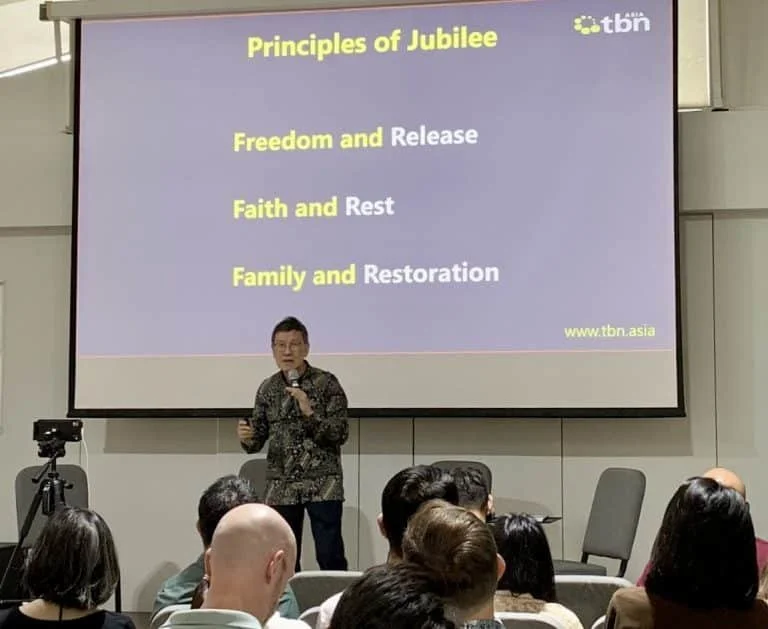
Melvyn Mak opened the inaugural Redemptive Real Estate Forum by presenting the Theology of Land.
Melvyn Mak, Chairman and co-founder of Transformational Business Network Asia (TBN Asia), opened the forum by sharing about the Theology of Land: Seeing land through the lens of God’s Kingdom.
TBN Asia is a not-for-profit organisation that focuses on using businesses with social impact to alleviate poverty in Southeast Asia.
In his sharing, Melvin drew from his personal experience – 18 years as a banker and stockbroker, 18 years as a pastor at Faith Community Baptist Church, and another 18 years combining both marketplace and the Church.
Here is an excerpt of his sharing.
Seeing land through God’s eyes
The Theology of Land is a profound biblical theme that moves far beyond transactions to address identity, justice, stewardship and divine purpose. Scripture establishes three non-negotiable foundations:
1. God owns the land
The starting point is recognising that the earth belongs to the Lord (Psalm 24:1). Land is not merely a commodity, but part of God’s good creation (Genesis 1:9-10).
In the Abrahamic covenant, God gave the land as a gift and an assignment. His ownership is unconditional, but our occupation is conditional – it is dependent on faithfulness and stewardship.
This reframes our understanding: We are not absolute owners, but trustees of what God ultimately owns.
2. We are to be His stewards of the land
If God is the true owner, then our role is that of stewards.
Genesis 2:15 calls humanity to “work it and take care of it”. This care is profoundly expressed in the Jubilee principle found in Leviticus and Deuteronomy – a radical socio-economic system designed by God to prevent permanent poverty and inequality.
Deuteronomy 15:4 says: “However there need not be poor people among you, for in the land the Lord God is giving you to possess as your inheritance, He will richly bless you.”
This Jubilee Programme is a multi-layered expression of God’s heart for justice:
The Gleaning Principle: Leaving the edges of fields for the poor and foreigners (Leviticus 23:22).
The Tithing Programme: Storing a third-year tithe to support the Levites, foreigners, orphans and widows (Deuteronomy 14:28-29).
The Sabbath Programme: A year of rest (every seventh year) for land, slaves and animals, coupled with debt cancellation (Deuteronomy 15:1-2).
The Jubilee programme: The ultimate reset every 50 years, in which debts are forgiven, slave are freed and ancestral land is returned. It was a systemic intervention to restore family, dignity and shalom (Leviticus 25:10-12).
Jesus launched His ministry by proclaiming this Jubilee (Luke 4:18-19), and the early Church lived it out, ensuring “there were no needy persons among them” (Acts 4:34).
The goal of the Jubilee Gospel is to bring shalom to all.
In modern terms, we call this human flourishing. It is the well-being of people financially, mentally, socially, physically, relationally and spiritually.
You can’t have human flourishing with no roof over your head, no running water or sanitation. The economic side of it is very important.
3. Land is a means of God’s blessing
Finally, land is a medium of God’s blessing and relationship with His people.
It is meant to be a “land flowing with milk and honey”, a tangible sign of covenant faithfulness.
Conversely, exploitation and injustice on the land bring national brokenness.
This theology moves beyond theory into urgent contemporary application.
What this looks like today
The basis of redemptive real estate is about using property as a tool for mission – to restore communities, promote justice and create spaces where people and creation can thrive.
It is a call to developers, investors, homeowners and churches to ask: How can my use of real estate make Jubilee principles of freedom, rest and family renewal tangible in our neighbourhoods and cities?
Some ideas to apply Jubilee principles to today, in the context of redemptive real estate:
Affordable housing and urban justice: Viewing housing as a right tied to dignity, not just an asset.
Reimagining housing not merely as investment vehicles, but as spaces for family restoration where multi-generational bonds can flourish.
Designing developments with hospitality baked into the blueprint: Creating room at the edges for the foreigner, the marginalised, the overlooked.
Environmental care and climate justice: Exercising creational stewardship (Hosea 4:1-3). Viewing urban planning through the lens of creation care – stewarding not just buildings but ecosystems, biodiversity and climate resilience.
Ethical agriculture and food security: Building just food systems.
Honouring indigenous rights and immigrants: Acknowledging history and practising biblical hospitality.
Structuring capital flows that prioritise justice over extraction – where returns serve community flourishing rather than displace it.
Redemptive real estate is not about abandoning profitability. As one practitioner in the Redemptive Real Estate Collective observed, it is about pursuing an “eternal return on investment”, where economic sustainability serves God’s purposes, rather than contradicts them.
The Redemptive Real Estate Collective comprises:
• Daniel Long and Terrance Tan, Olive Tree Estates
• Edmund Ng and Katherine Poh, Doxa Holdings
• Pastor Melvyn Mak, Transformational Business Network Asia (TBN Asia)
• Lynette Leong, Acacia Capital
• Lim Yau Boon, Eu Chin Fen, and Lisa Chan
This event was supported by 360 (formerly known as Digital Mission @ 360), represented by Pastor Dr Paul Choo.
To explore how you can be part of the conversation at future Redemptive Real Estate gatherings, or to consider what Jubilee justice might look like in your own sphere of influence, email RRE.Collective@gmail.com.