
Enterprise Solutions to Poverty: Dr Kim Tan at the TBN Americas Forum
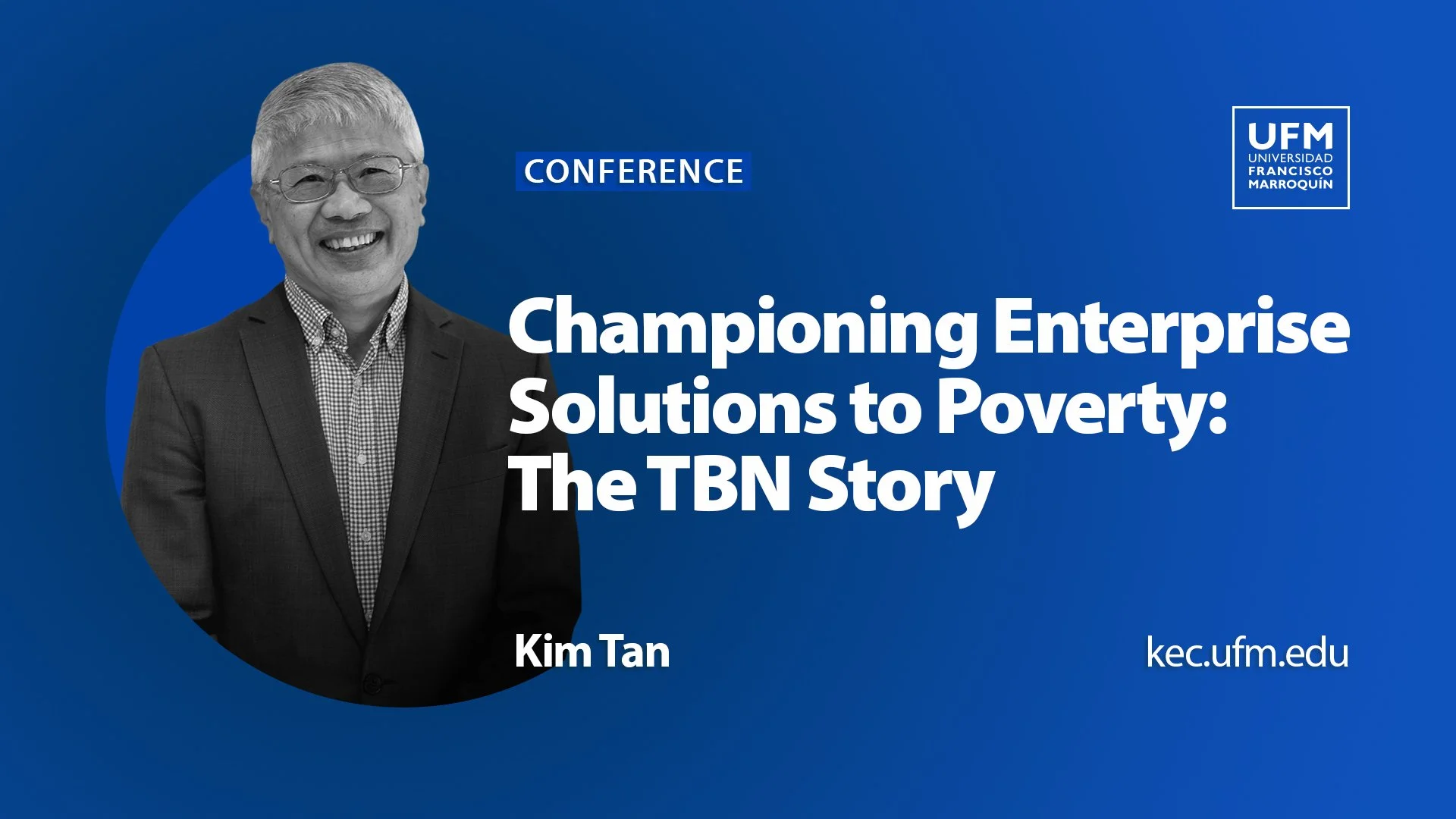
Video source: TBN Americas Forum, hosted by Universidad Francisco Marroquín (UFM), Guatemala.“Unless we enable the poor to own assets, they will always remain in the informal economy.”
Dr Kim Tan, founder of the Transformational Business Network (TBN), took the stage at the TBN Americas Forum, hosted by Universidad Francisco Marroquín in Guatemala, to share 25 years of lessons from building enterprises that fight poverty. He described TBN's members with characteristic candour: a network of disillusioned philanthropists and repentant bankers, lawyers, and consultants looking to put their skills to more meaningful use.
The founding insight came from two uncomfortable charts. The first showed decades of aid flowing into sub-Saharan Africa alongside a corresponding drag on GDP. The second showed the "missing middle" — developing economies are crowded with micro-enterprises and dotted with a handful of multinationals, but starved of the small-to-medium businesses that drive real economic transformation. Micro-loans of a few hundred dollars are easy to get; so, if you're politically connected, are multi-million-dollar loans. Everything in between is nearly impossible to finance.
That gap is what TBN has spent 25 years trying to close — starting with individual investors putting in $10,000–20,000, and growing into a network that now includes sovereign wealth funds (Norfund, FMO, Proparco), the British government, JP Morgan Social Finance, and a fast-growing list of family offices. A new fund in Kenya has persuaded local pension funds to allocate 1% of assets under management to small and medium enterprise financing — a small shift for pension portfolios, but potentially transformative for the businesses it reaches.
A Spectrum of Financing Tools
Dr Tan walked through the range of instruments TBN uses depending on what a business needs: equity at one end, philanthropic grants at the other (including a growing trend of "repayable grants" that keep entrepreneurs accountable even when there's no expectation of return), convertible loan notes that let entrepreneurs defer valuation conversations, concessionary debt, revenue-based repayments that flex with a business's cash flow, and increasingly, carbon finance.
Case Studies from the Portfolio
Samara Game Reserve, South Africa — Dr Tan's first investment, 25 years ago: 40,000 acres of degraded farmland, elephant-proof fencing, and a five-star lodge built to catalyse jobs in a district with 85% unemployment. It was financed through a concessionary loan from the Eastern Cape Development Corporation and a royalty-based arrangement with South Africa's National Parks Board for the animals themselves — TBN paid a share of revenue until it could buy the wildlife outright, which it has since done.
Carbon-financed reforestation — Using the same reserve's degraded land, TBN spent eight years learning to grow a local plant called spekboom, then used verified carbon-capture data to pre-sell the project on the compliance carbon market (priced far higher than the voluntary market) — raising roughly $17–20 million to plant 30 million cuttings across 12,000 acres and employ around 350 people.
Low-cost schools — What began as one $40,000 school in Nairobi's Kibera slum in 2009 has grown into a network of 10,000 schools serving 3 million children. Curriculum runs on tablets; fees and staff pay run through mobile money to cut overhead. Philanthropic grants funded early curriculum experiments — including data-driven trials on the best way to teach English to Swahili-speaking children — before the model scaled as a profit-based enterprise.
Agape, Singapore — A call centre built inside a Singapore prison, founded by a man who had served eight years there himself. It took TBN six months of relationship-building before they'd consider funding him. The $500,000 investment created the only air-conditioned room in the prison and, since release, has grown into a 250-person profitable business paying dividends to shareholders — now expanding to six prisons in Indonesia and to refugee communities in Malaysia.
BasiGo and Max, Kenya & Nigeria — Nairobi's first electric bus company, structured on a pay-as-you-drive model so drivers own their buses outright within six to seven years. The logic, as Dr Tan put it, is that banks only lend to people who already have collateral — so without a path to owning an asset, the poor stay locked out of the formal economy. The same model applies to Max, an electric motorbike business in Nigeria with over 30,000 riders.
Coco — A bioethanol distribution business reaching over 1 million Kenyan households through existing petrol station infrastructure and mobile-money-enabled kiosks, with carbon credits used to subsidise fuel costs for low-income families.
Sanergy, Kenya — A franchise network of pay-per-use toilets serving 270,000 people a day across Kenya's slums, run largely by women entrepreneurs. Early philanthropic grants funded experiments turning waste into organic fertiliser and black soldier fly protein for animal feed — now one of Africa's largest insect-protein factories, built with support from the International Finance Corporation.
Budongo Forest, Uganda — TBN's newest project: an 800-square-kilometre forest, and the second field station of the late primatologist Jane Goodall, home to 600 chimpanzees and roughly 50% degraded. Dr Tan noted Goodall's passing shortly before the forum, at age 91. The cause of the deforestation, he explained, is poverty — families earning around $300 a year cut trees for charcoal to survive. TBN's response is to build a lodge and several factories, including a dried-fruit facility, to give the community livelihoods that make reforestation and income the same project rather than competing ones.
The Closing Thought
Dr Tan closed on the line that ties the portfolio together: the environment is not the problem — people are, and solving the human problem is a precondition for solving the environmental one. Across every story, the same principle holds: dignity and income have to arrive together, and ownership of a real asset is often what moves someone from surviving to transforming.