
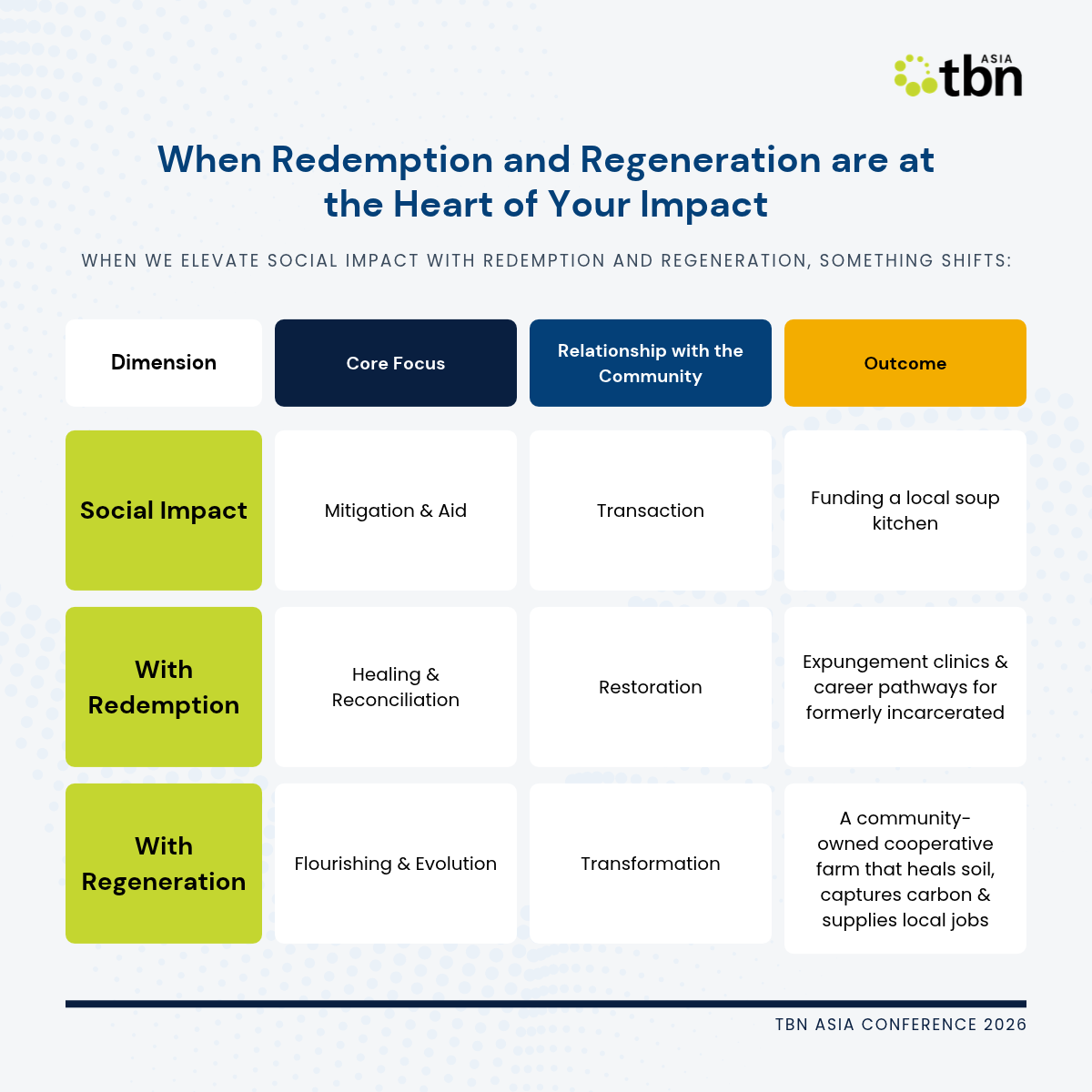
When we elevate social impact with redemption and regeneration, something shifts:
We love to talk about growth, scaling and impact. Perhaps we need to ask a more fundamental question first: what needs to be repaired before we can scale?
At the recent TBN Conference in Jakarta, Gregory Vijayendran shared:
Redemption – healing what was broken. It interrupts destructive cycles, restores dignity, value, and allows people to move beyond their past.
Regeneration – creating the capacity for new beginnings. It goes beyond repairing damage. It rebuilds living systems, relationships and structures that allow people and communities to flourish over time.
We cannot meaningfully regenerate without first addressing what is broken. We must look backwards to repair before looking forward to multiply. Otherwise, we are simply managing the damage.
Greg shared on restorative and therapeutic justice using real life case studies. In the pursuit of truth, we can still treat every client like a human, especially the vulnerable. Courts can restore dignity and legal processes can be structured to support the psychological and emotional well-being of all involved. Applying it to businesses, to humanize the client has never been more important than now in the age of AI. We love to talk about human flourishing, look no further than redeeming what it is that makes as humans.
Drawing from his almost two decades of social service experience, Greg shared that regeneration is moving from rescue to building systems and architecture. Majority of philanthropy focuses on rescue. However, we need to be able to distinguish between simply helping people and building systems that address unmet needs, key to this is knowing when NOT to do something.
During his involvement with a charity for children with chronic illnesses, they had initially undertaken blood donation initiatives but realized that the Red Cross was already doing this far more effectively. They also considered supporting children with cancer, but recognized that the Children's Cancer Foundation was better positioned to serve that group. Rather than duplicating existing efforts, they redirected their attention towards needs that were not being adequately addressed.
This is an important lesson for social enterprises and impact orgs: impact is not measured by how many activities we undertake, but by whether we are addressing a genuine gap. Sometimes, the most strategic decision is to stop doing something.
Finally, the journey from rescue to architecture. Greg challenged the tendency for orgs to rely on a few individuals, calling it a superhero mindset. This is a barrier to regeneration because it creates dependency, limits the contributions of others, and leaves the org vulnerable when key people leave.
We can’t rely on only a few individuals. We need to build systems that addresses real needs, empower others to take ownership, establish practices that become part of organizational culture, and plan for succession. This is what happens when impact becomes embedded in the system rather than dependent on individual goodwill.
Redemption heals, Regeneration hopes.
Repair what is broken, restore dignity and agency.
Build what can grow. Create capacity for new beginnings and lasting growth.
These don’t happen by accident. They require intentionality, conviction and a willingness to act when a need becomes apparent.
What is one thing you can redeem?
What is one thing you can build?
Who is one person you can raise?
The race to the top starts with the bottom. How solid is your foundation?